
Knee Pain, Runner's Knee and IT Band Syndrome

Ready to find out what's really behind your knee pain?
New patients welcome from Kennewick, Richland, Pasco, West Richland and across the Tri-Cities.
Book Online Call (509) 820-3828
Knee pain can stop you from running, hiking, squatting, kneeling or even walking down stairs comfortably. The knee is mostly a hinge, so it's at the mercy of the joints above and below it. If your hip or ankle isn't doing its job, the knee often pays for it. At ICE in Kennewick we treat the knee and we also look at what's loading it.
Common types of knee pain
- Patellofemoral pain (runner's knee): a dull ache around or behind the kneecap, worse with stairs, squatting, or sitting with bent knees
- IT band syndrome: pain on the outside of the knee, common in runners and cyclists, often starting partway into a run
- Chondromalacia patella: softening or irritation of the cartilage under the kneecap
- Patellar tendon pain (jumper's knee): pain just below the kneecap
- Pain behind the knee, which can involve the popliteus muscle, hamstring tendons or a Baker's cyst
- Meniscus and ligament sprains after twisting or sports injuries
- Knee arthritis: stiffness and aching, often worse after rest
Common causes: the kinetic-chain view
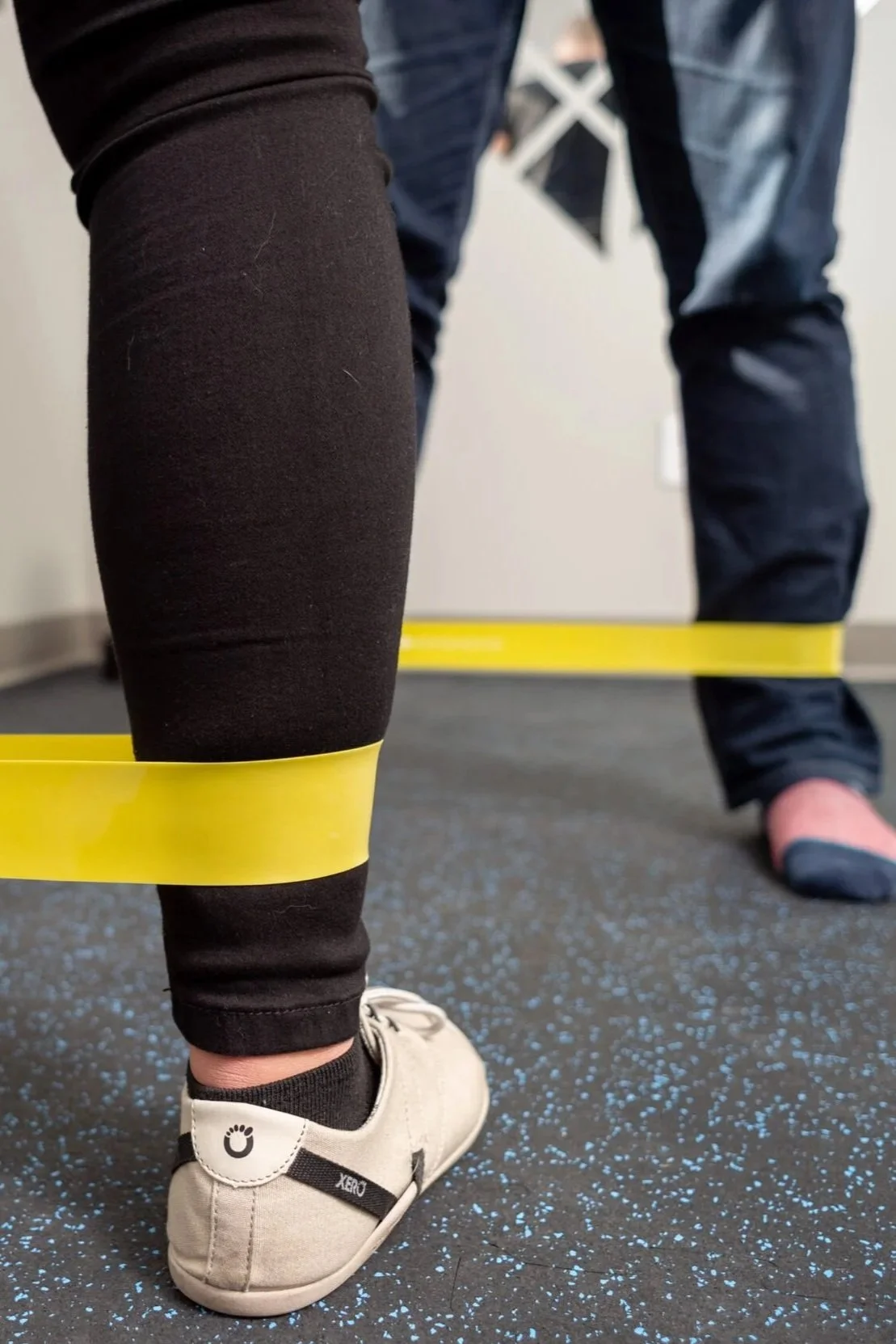
- The hip: weak or underactive glutes let the thigh drop and rotate inward when you land, run or climb stairs, which pulls the kneecap off its ideal track.
- The ankle and foot: a stiff ankle, flat or rigid feet, or a big toe that won't bend well forces the knee to twist or bend more than it should.
- Tight structures: a tight hip, quads or calves change how the kneecap glides.
- Training errors: too much mileage too soon, lots of downhill running, or new shoes or terrain.
- Old injuries: an ankle sprain or hip problem from years ago can leave a compensation pattern behind.
Watch: The REAL Reason Your Knee Pain Keeps Coming Back (Most People Miss This)
Symptoms
- Aching around or behind the kneecap with stairs, squats or prolonged sitting
- Sharp pain on the outside of the knee during running or cycling
- Swelling, stiffness, clicking or grinding
- Pain behind the knee when straightening fully
- Locking, catching or the knee giving way (these need prompt evaluation)
How ICE treats knee pain
We start with your story, then examine the knee and test how your hip, ankle and foot move and how well the muscles that control the knee are firing, including single-leg squat and balance tests. After treatment we re-test the movements that hurt so you can see what changed.
Your plan may include:
- Extremity adjustments for the knee, kneecap, the small joint at the top of the shin (fibula), the ankle, foot and hip.
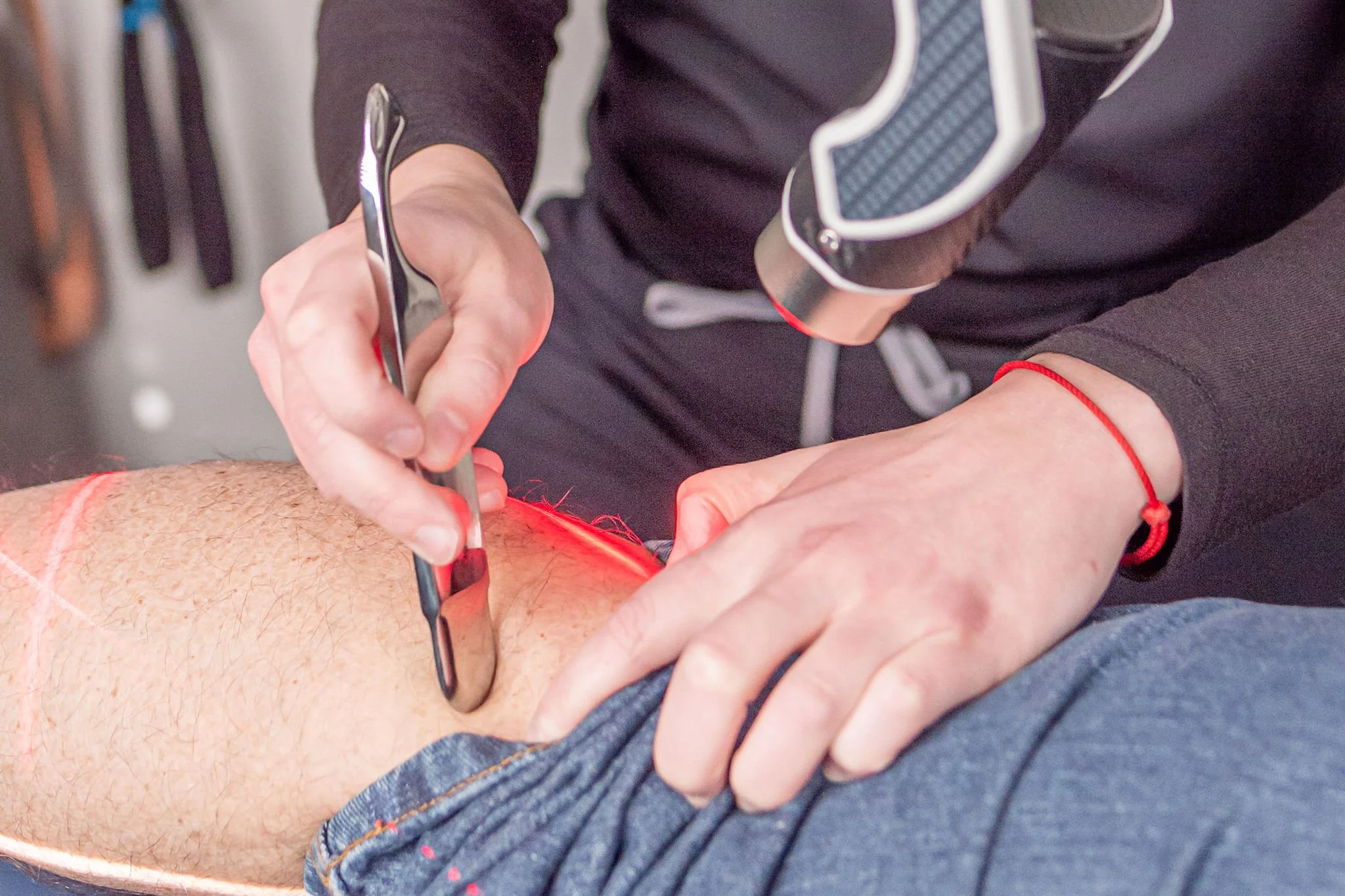
- Low-level laser therapy to help calm irritated tissue around the knee.
- Manual therapy and functional cupping for the quads, IT band region, hamstrings and calves.
- Kinesiology taping for kneecap support while you stay active.
- Corrective exercises: hip and glute activation, quad strength, ankle mobility and landing mechanics, done briefly and often at home.
- Spinal adjustments if the low back or pelvis is involved.
Watch: Hip Tightness Is Causing Your Knee Pain (Here’s Why)
Treated by an extremity-certified chiropractor who teaches other doctors
Knee pain is a classic case of 'where it hurts isn't where it started.' Your care at ICE is led by Dr. Kyle Bryant, DC, CCEP, the founder of Integrative Chiropractic and Extremities. Dr. Bryant is a Certified Chiropractic Extremity Practitioner (CCEP), an advanced credential awarded by the Council on Extremity Adjusting after 105 hours of advanced extremity training and a practical exam. He has 15+ years in practice, he teaches his extremity assessment approach to other chiropractors, and he has been invited onto several professional chiropractic podcasts to talk about extremity adjusting. A former collegiate, semi-pro and international soccer player, he knows first-hand what joint injuries do to the way an athlete moves.
He practices alongside Dr. Joseph Friedman, DC, who builds personalized plans around spinal and extremity adjustments and integrative therapies. Every patient gets extremity care as part of the evaluation, not as an add-on.
What to expect
Initial visits typically take 15–60 minutes, and in most cases treatment starts the same day. Follow-ups usually take 10–20 minutes. If you're a runner, we'll talk about how to keep training safely by adjusting mileage, hills and pace while your knee recovers.
At-home care
- Reduce the activities that flare your knee without stopping all activity. Cycling or swimming may be tolerated when running isn't.
- Avoid deep squats and long periods of sitting with knees sharply bent while the kneecap is irritated.
- Do your hip and ankle exercises daily. They often matter as much as the knee work.
When to see a medical doctor
Get prompt medical care if your knee swells quickly after an injury, locks so you can't straighten it, gives way repeatedly, or you can't put weight on it. A hot, red, swollen knee with fever, or calf pain, swelling and warmth (possible blood clot), needs same-day medical attention. If your exam suggests a significant meniscus or ligament tear, we'll refer you for imaging or an orthopedic opinion.
Frequently asked questions
Can a chiropractor help knee pain?
Yes, for many mechanical knee problems such as runner's knee, IT band pain and tendon irritation. Care addresses the knee and also the hip, ankle and foot that control it. Significant tears or unstable knees may need medical or surgical care, and we'll refer you if we find signs of them.
Should I foam roll my IT band?
Rolling may feel good for some people, but the IT band itself doesn't really 'stretch.' Outside-of-knee pain usually improves more from fixing hip control, training load and running mechanics.
Why does my knee hurt going down stairs?
Going downstairs puts high load on the kneecap joint while the thigh muscles control the descent. Weak hip and quad control or a stiff ankle commonly add to that stress.
Can my hip cause knee pain?
Very often. When the hip muscles don't control the thigh, the knee can collapse inward, which stresses the kneecap and the outside of the knee. Hip pain in children can also be felt in the knee, so children with knee pain and a limp should be checked.
Do I need to stop running?
Not always. Many runners can keep running with adjusted mileage, pace and terrain while they rehab. We'll help you find a level your knee tolerates.
Get your knee pain evaluated in Kennewick
You don't have to keep guessing. Our doctors will look at the painful area and the joints above and below it, show you what they find, and walk you through a plan you can understand.
Integrative Chiropractic and Extremities (ICE Clinics) · 7117 W Hood Pl, Ste 130, Kennewick, WA 99336
Hours: Mon/Wed/Fri 9:00–12:30 & 3:30–6:00 · Tue/Thu 9:00–12:30 & 2:30–5:00
Paying for care: we are primarily self-pay, and we also accept Medicare, auto injury claims and L&I (Washington Labor & Industries) claims. No referral is needed. See what to expect as a new patient.
Book Your Visit Online Call (509) 820-3828
Related conditions
Hip pain · Ankle sprains · Plantar fasciitis & heel pain · Sports injuries
Back to all conditions we treat.
This page is general health information, not a diagnosis or a promise of results. Everyone responds differently. If you have severe, sudden or worsening symptoms, please contact your medical provider or call 911.