
Plantar Fasciitis and Heel Pain

Ready to find out what's really behind your heel or foot pain?
New patients welcome from Kennewick, Richland, Pasco, West Richland and across the Tri-Cities.
Book Online Call (509) 820-3828
If your first steps out of bed feel like stepping on a tack, or your heel aches after standing on hard floors all day, you may have plantar fasciitis, one of the most common causes of heel pain. At ICE in Kennewick we treat the sore tissue under your foot and look for why it's being overloaded: how your foot, ankle, knee and hip move with every step.
What is plantar fasciitis?
The plantar fascia is a thick band of tissue that runs from your heel bone to the base of your toes. It supports your arch and acts like a spring when you walk and run. When it's loaded more than it can handle, the area where it attaches to the heel becomes irritated and painful. Longer-standing cases are often more about tissue overload and degeneration than inflammation, so treatment aims to unload the fascia and gradually rebuild the foot's strength and mobility.
Other causes of heel and foot pain we evaluate include:
- Achilles tendon pain at the back of the heel (see Achilles tendinitis)
- Heel fat pad irritation
- Tarsal tunnel syndrome, an irritated nerve on the inside of the ankle that causes burning or tingling
- Morton's neuroma (pain between the toes) and big-toe stiffness (hallux rigidus)
- Stress fractures, which need medical imaging
Common causes: the kinetic-chain view
- A stiff ankle or tight calves: when the ankle can't bend well, the arch and plantar fascia take extra strain.
- A big toe that won't bend: your big toe should extend every time you push off. When it can't, the fascia is pulled harder. (Our post on bunions and footwear explains why big-toe motion matters so much.)
- Stiff joints in the foot: the heel bone (calcaneus) and midfoot joints need to move for the foot to absorb shock.
- Weak foot and hip muscles: when the small muscles of the foot and the hip stabilizers underperform, the arch collapses more with each step.
- Load changes: a new job on hard floors, more walking or running, weight gain, or worn-out or unsupportive shoes.
Symptoms
- Sharp heel pain with your first steps in the morning or after sitting
- Pain that eases after warming up, then returns after long periods on your feet
- Tenderness on the bottom inside edge of the heel
- Pain that's worse barefoot on hard floors
How ICE treats plantar fasciitis
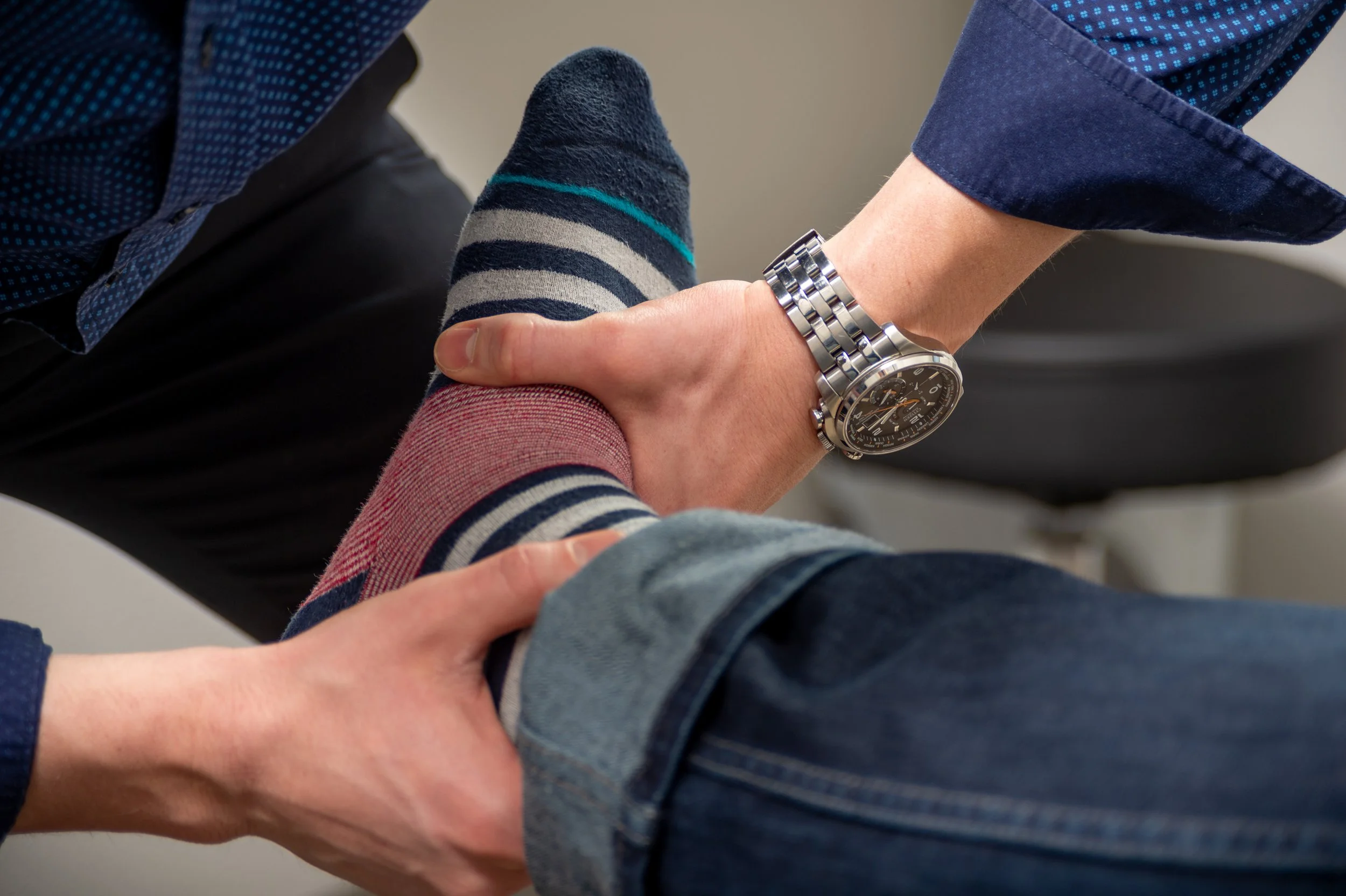
We examine your foot, ankle, knee and hip; watch how you stand, walk and balance on one leg; and test the motion of your heel, midfoot and big toe and the strength of the muscles that support your arch. After treatment we re-test so you can feel the difference in how your foot moves and loads.
Your plan may include:
- Extremity adjustments for the heel bone, midfoot, big toe and ankle, plus the knee and hip if needed.
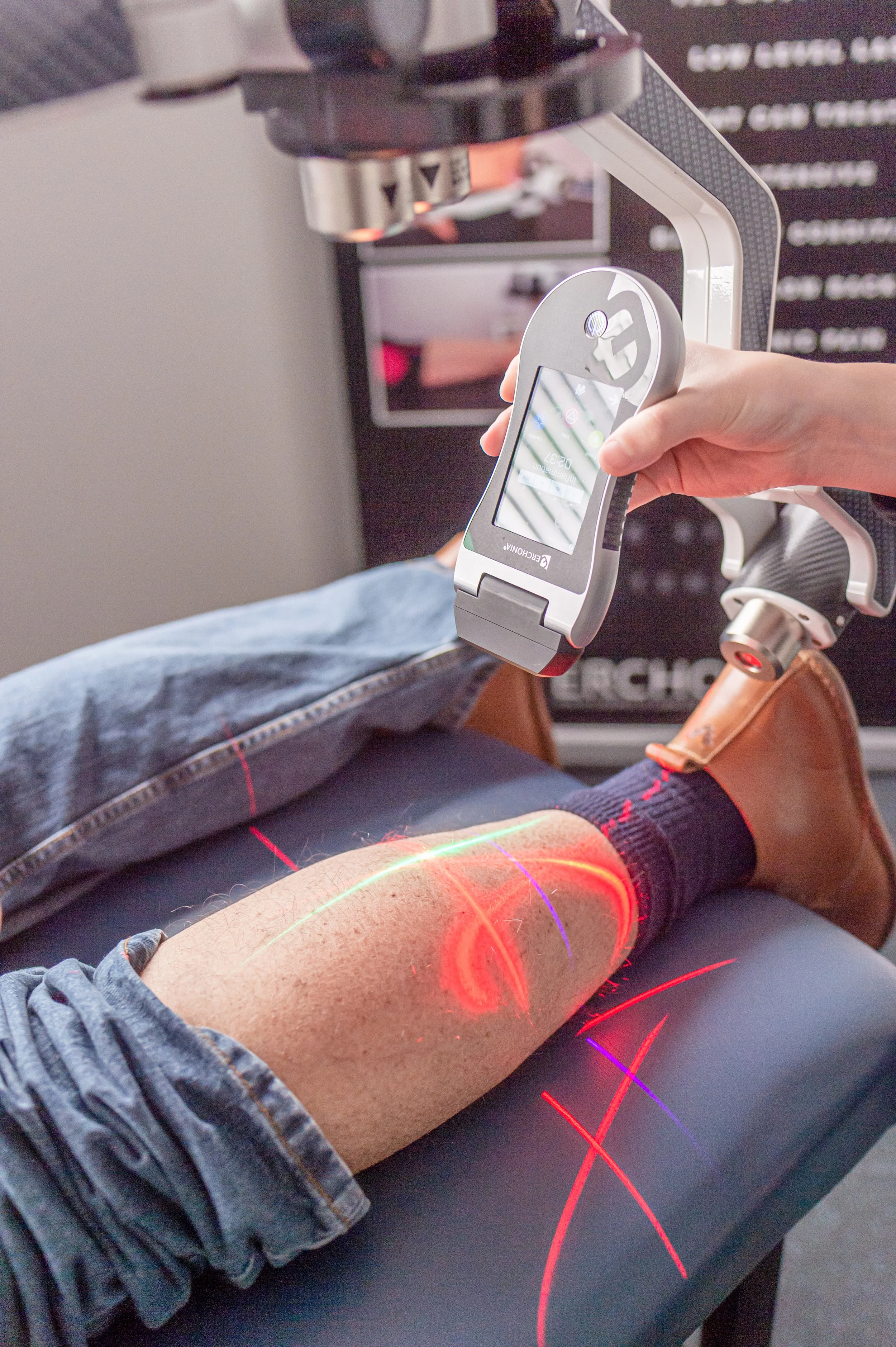
- Low-level laser therapy to help calm the irritated attachment and support healing.
- Manual therapy, including instrument-assisted soft tissue work, and functional cupping for the calf and the sole of the foot.
- Kinesiology taping to offload the fascia during the day.
- Corrective exercises: calf and fascia loading, toe and arch strength, ankle mobility and hip stability, kept short so they're easy to do daily.
- Practical footwear guidance, including toe-box width and support for long shifts.
Treated by an extremity-certified chiropractor who teaches other doctors
Feet are the foundation of the kinetic chain, and they're often overlooked. Your care at ICE is led by Dr. Kyle Bryant, DC, CCEP, the founder of Integrative Chiropractic and Extremities. Dr. Bryant is a Certified Chiropractic Extremity Practitioner (CCEP), an advanced credential awarded by the Council on Extremity Adjusting after 105 hours of advanced extremity training and a practical exam. He has 15+ years in practice, he teaches his extremity assessment approach to other chiropractors, and he has been invited onto several professional chiropractic podcasts to talk about extremity adjusting. A former collegiate, semi-pro and international soccer player, he knows first-hand what joint injuries do to the way an athlete moves.
He practices alongside Dr. Joseph Friedman, DC, who builds personalized plans around spinal and extremity adjustments and integrative therapies. Every patient gets extremity care as part of the evaluation, not as an add-on.
What to expect
Initial visits typically take 15–60 minutes, and most people receive their first treatment the same day. Follow-ups usually take 10–20 minutes. Plantar fasciitis can be stubborn, especially if it has been present for months, so consistent home care makes a big difference.
At-home care
- Avoid going barefoot on hard floors while the heel is sore. Wear supportive shoes or sandals around the house.
- Do your calf and foot exercises before your first steps in the morning and after long periods of sitting.
- Increase walking or running gradually, and replace worn-out shoes.
Watch: Avoid Plantar Fasciitis with these 3 Tips
When to see a medical doctor
See a medical provider if heel pain started with an injury and you can't walk on it, if the heel is red, hot or swollen, if you have numbness or burning in the foot, or if pain is constant and present at rest or at night. People with diabetes or circulation problems should have any foot pain, sores or color changes checked promptly. If we suspect a stress fracture or another problem that needs imaging, we'll refer you.
Frequently asked questions
Can a chiropractor treat plantar fasciitis?
Yes. Chiropractors trained in extremity care can work directly with the joints of the foot and ankle, the surrounding soft tissue and your movement patterns. Those are often what keep plantar fasciitis from settling.
Why does my heel hurt most in the morning?
Overnight, the plantar fascia and calf tighten in a shortened position. Your first steps stretch the irritated tissue suddenly. Gentle foot and calf movement before getting up often helps.
Do I need custom orthotics?
Not always. Some people benefit from arch support, but many improve with better foot mobility, stronger foot and hip muscles and better-fitting shoes. We'll recommend support only if your exam suggests it.
How long does plantar fasciitis take to go away?
It varies. Recent cases may settle in weeks, while long-standing cases can take a few months. Consistent home exercises and load management make the biggest difference.
Can my hip really affect my heel?
It can. Weak hip stabilizers let the knee drift inward and the arch collapse more with each step, which adds strain on the plantar fascia. That's why we check the whole leg.
Get your heel or foot pain evaluated in Kennewick
You don't have to keep guessing. Our doctors will look at the painful area and the joints above and below it, show you what they find, and walk you through a plan you can understand.
Integrative Chiropractic and Extremities (ICE Clinics) · 7117 W Hood Pl, Ste 130, Kennewick, WA 99336
Hours: Mon/Wed/Fri 9:00–12:30 & 3:30–6:00 · Tue/Thu 9:00–12:30 & 2:30–5:00
Paying for care: we are primarily self-pay, and we also accept Medicare, auto injury claims and L&I (Washington Labor & Industries) claims. No referral is needed. See what to expect as a new patient.
Book Your Visit Online Call (509) 820-3828
Related conditions
Achilles tendinitis · Bunions · Ankle sprains · Knee pain & IT band
Back to all conditions we treat.
This page is general health information, not a diagnosis or a promise of results. Everyone responds differently. If you have severe, sudden or worsening symptoms, please contact your medical provider or call 911.